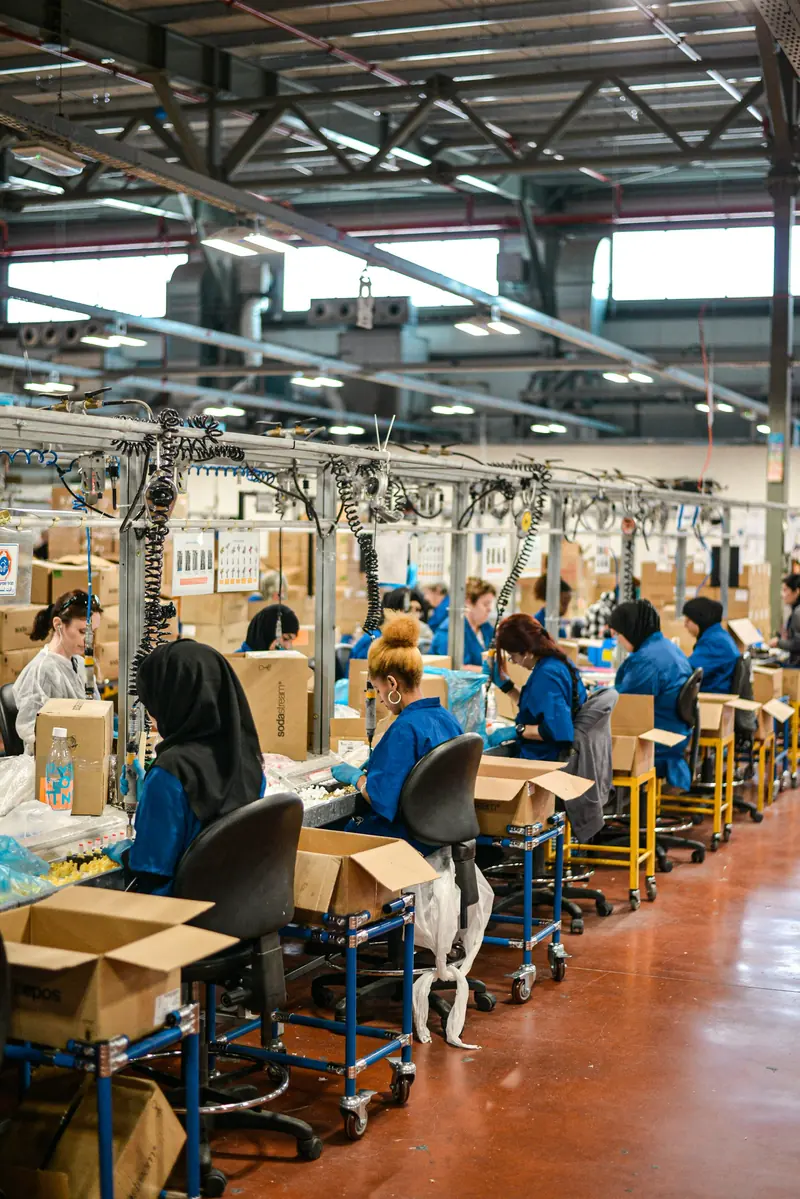
Running a plant is a numbers game. You watch scrap rates, overtime and freight costs every week, and health insurance tends to show up as one more line item that only goes up. It deserves the same attention you give the rest of the operation, because the right plan helps you hold onto trained people and the wrong one quietly pushes them toward the shop down the road.
This page covers what makes coverage for Missouri manufacturers and distributors different: where the work happens, who counts as eligible, how long new hires can wait, and what changes once you reach 50 full-time equivalents.
How many Missourians make things for a living
The BLS Quarterly Census of Employment and Wages puts Missouri manufacturing at 281,886 private jobs across 8,864 establishments for the 2025 annual average. That is roughly one in nine of the state's 2,483,283 private sector jobs. Wholesale trade, where most distributors land, adds another 125,704 jobs at 12,283 establishments.
Pay sits above the state norm. Average annual pay in Missouri manufacturing was $77,859 in 2025, compared with $67,290 for all private employers. That matters for plan design. A crew earning steady wages can usually handle a modest payroll deduction, so the question becomes less about whether people can afford a plan and more about whether the plan actually covers the doctors they use.
Plants outside the metros, and the people who commute in
Plenty of Missouri manufacturing happens far from Kansas City and St. Louis. The same BLS data shows how much some counties lean on it:
- Barry County: 4,646 of 11,293 private jobs, about 41 percent, are in manufacturing.
- Laclede County: 4,285 of 11,450 private jobs, about 37 percent.
- Buchanan County (home of St. Joseph): 12,154 of 40,774 private jobs, about 30 percent.
- Pettis County: 4,876 of 16,027 private jobs, about 30 percent.
A plant in a county like these rarely hires only from its own town. Second shift might include someone from two counties east, a maintenance tech who lives across the Kansas line, and a forklift operator who moved closer to family last spring. Their doctors and hospitals follow where they live, not where they clock in.
Here is why that matters for pricing too. Your small group rate is set by the CMS rating area of your business address. Barry and Laclede counties sit in area 8 (Springfield), Buchanan sits in area 1 (Northwest), and Pettis sits in area 4 (West central). The carriers filing small group plans differ by area, so the menu you see depends on where the plant is.
Picking a network for a crew spread over several counties
For a plant with commuters, the network question comes first and the deductible comes second. A plan with a low deductible does nobody any good if the family doctor in the next county is out of network.
Here is how we handle it. We ask for a census with each employee's home zip code, then check the networks of the carriers filing in your area against where people actually live. In the 2026 CMS filings, every Missouri small group plan is a PPO or EPO. A PPO pays something toward out-of-network care. An EPO generally does not, outside of emergencies, but often costs less. For a scattered crew, that tradeoff is worth a real look.
A few local wrinkles we watch for:
- In rating areas 1, 3 and 4, the Blue plan comes from Blue KC. In the other areas where a Blue plan is filed, it comes from Anthem Blue Cross and Blue Shield.
- UnitedHealthcare and National Health Insurance Company filed small group plans in all 10 areas for 2026.
- Plants near the state line may have workers who use Kansas or Illinois providers. Our pages on Missouri and Kansas and Missouri and Illinois groups cover that.
Second shift, third shift, and who counts as eligible
Missouri law decides who belongs in your small group count. Under RSMo 379.930, an eligible employee works full time with a normal work week of 30 or more hours. Part-time, temporary and substitute workers are left out of that definition. A small employer, under the same statute, averaged at least 2 and no more than 50 eligible employees on business days in the prior calendar year.
Shift work does not change the 30-hour line. A night crew on four 10-hour shifts is full time. So is a day crew on five 8s. What trips up plants is the in-between group:
- Temp-to-hire workers. While someone is on a staffing agency's payroll, your agreement with the agency usually spells out who provides benefits. Once they move to your payroll in a 30-hour role, they count toward your group.
- Weekend-only crews. Two 12-hour shifts is 24 hours. Under the state definition, that is part time unless you choose to include them.
- Peak season hires. Temporary help brought on for a rush is outside the Missouri definition of an eligible employee.
Write your eligibility rule down as a class, such as "all employees in a position scheduled for 30 or more hours per week," and apply it the same way on every shift. Our small business health insurance requirements page goes through participation and contribution rules in more detail.
The 90-day cap on waiting periods
Turnover in the first few months is a fact of plant life. A waiting period keeps you from enrolling someone who walks off after week three. Federal rules put a ceiling on it: a group health plan cannot apply a waiting period longer than 90 days.
Count carefully. The regulation counts every calendar day starting on the enrollment date, weekends and holidays included. So a "90-day" rule means coverage starts no later than day 91, not "the first of the month after 90 days." Many plants instead pick "first of the month after 60 days," which stays safely inside the cap.
Two other options can fit manufacturing:
- An orientation period of up to one month, such as a safety training and skills check, can come before the 90-day clock. The rule measures it as one calendar month minus a day.
- A cumulative hours requirement for part-time roles, capped at 1,200 hours. Once someone hits that mark, the 90-day limit applies from there.
Whatever you choose, the carrier's own rules for your plan also apply. We check those against what you want before anything goes into writing.
When a plant reaches 50 full-time equivalents
This is the line that catches growing shops. Two counts run side by side, and they do not always agree.
Missouri counts eligible employees for small group purposes. The IRS counts full-time employees plus full-time equivalents to decide whether you are an applicable large employer under the Affordable Care Act. For the IRS count, full time means 30 or more hours a week, or 130 hours in a month. To find FTEs, add the monthly hours of everyone else (capping each person at 120) and divide by 120. The test looks at your average over the prior calendar year.
So a plant with 46 full-time workers and a pile of part-time packers can be a small group under state law while the IRS treats it as a large employer. If that is you, two rules come into play:
- Offer coverage to at least 95 percent of full-time employees and their dependent children, or face a possible IRS assessment.
- Keep it affordable. For plan years starting in 2026, the employee's share of the cheapest self-only plan that meets minimum value should not exceed 9.96 percent of household income. Employers test this with safe harbors based on W-2 wages, rate of pay, or the federal poverty line.
Distributors that add a second warehouse or a few delivery routes can cross this line within a year. Our large group health insurance page lays out what changes on the carrier side once you have 51 or more eligible employees.
HSA plans and wellness for younger crews
Many plants have a split crew: a group of long-tenure people near retirement and a younger group who rarely see a doctor. One plan design rarely fits both.
A high-deductible plan paired with a health savings account (HSA) often appeals to younger workers who would rather keep premiums low and build a balance. For 2026, IRS figures say an HSA-qualified plan needs a deductible of at least $1,700 self-only or $3,400 family, and out-of-pocket costs can run no higher than $8,500 self-only or $17,000 family. The 2026 HSA contribution limits are $4,400 self-only and $8,750 family, counting any employer deposit.
A common setup for plants is two plans side by side: an HSA plan as the low-cost option and a copay PPO for workers who see the doctor more often. Wellness pieces, like on-site flu shots or a biometric screening day timed between shifts, can ride along. Ask what each carrier includes at no extra charge before you pay for a separate vendor. Compare designs on our group health plan types page, and look at level-funded plans if your crew skews young and healthy.
Pulling your quote together
To price a plant or warehouse, we need a census with each employee's date of birth, home zip code, hours, and whether they want employee-only or family coverage. Add your current plan and renewal if you have one, and a note on any shift or location changes coming this year.
From there we line up the carriers filed for your rating area and show you how each network covers your crew. Start a quote request, or email [email protected] with your census.
Sources
- BLS QCEW, Missouri 2025 annual averages by industry
- BLS QCEW, 2025 annual averages for manufacturing (NAICS 31-33) by county
- BLS QCEW, 2025 annual averages, all industries by county
- Missouri Revised Statutes 379.930, definitions (small employer, eligible employee)
- 29 CFR 2590.715-2708, 90-day waiting period limit
- IRS, determining if an employer is an applicable large employer
- IRS, questions and answers on employer shared responsibility
- IRS Rev. Proc. 2025-25 (2026 required contribution percentage)
- IRS Rev. Proc. 2025-19 (2026 HSA and HDHP limits)
- CMS Unified Rate Review public use file, plan year 2026
- CMS, Missouri geographic rating areas